
Dust Collection and Chip Evacuation
How CNC dust collection works, how to choose between a shop vac, dust collector and dust extractor, and the static, fire and health hazards to plan for.
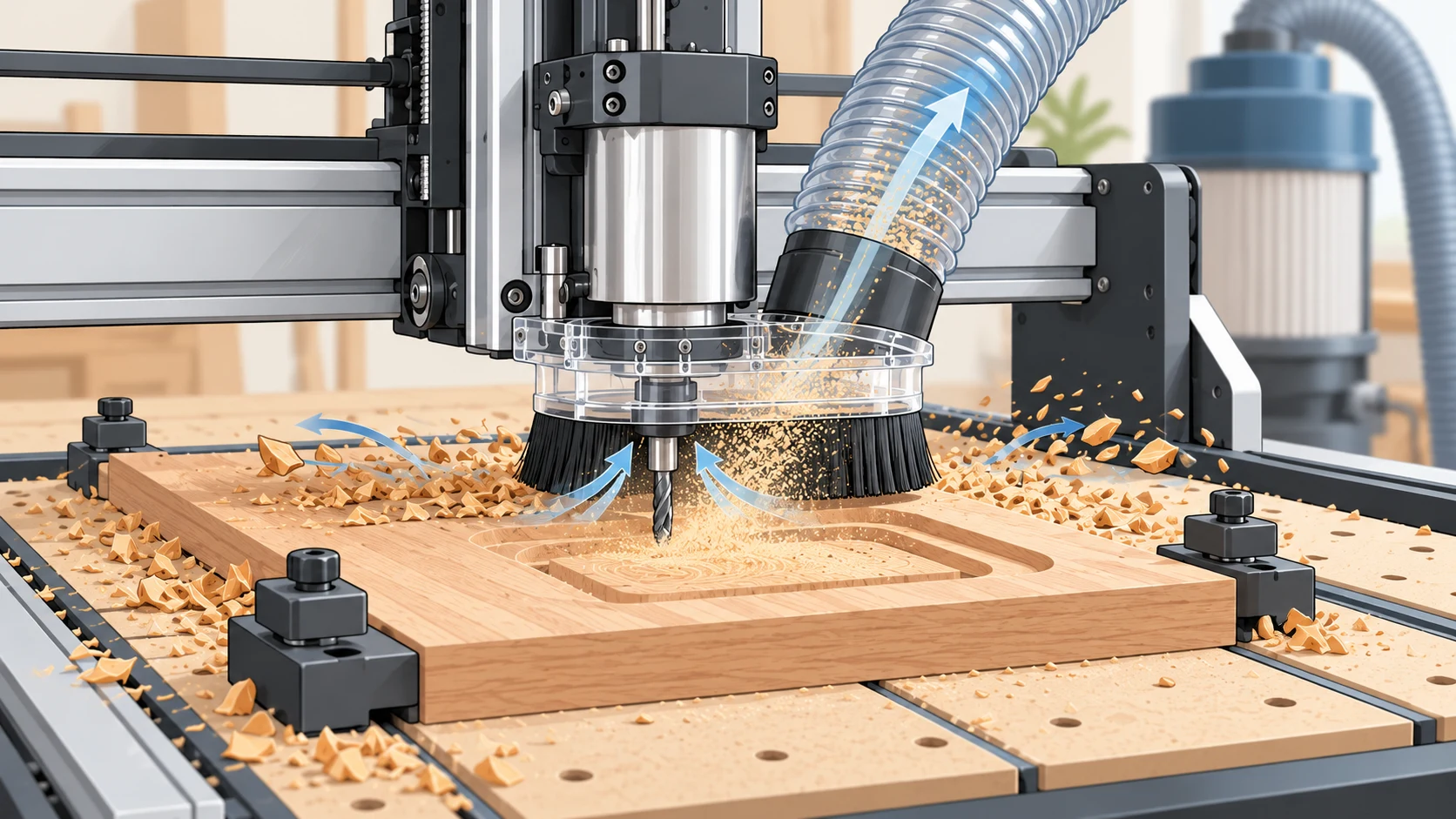
Table of Contents▼
A CNC machine turns a block of material into a pile of chips and a cloud of dust. Left alone, that debris gets into the cut, onto the machine and into your lungs. This guide explains how dust collection works, how to choose between the common options, and which safety points deserve your attention before the first cut.
Most beginners treat dust collection as an accessory to add later. It is better to plan it together with the machine, the first material and the place where the machine will live, because each of these changes what you need. The sections below follow that order: first the parts, then the ratings, then the choices, and finally the hazards that are easy to miss.
What a dust collection system is
A CNC dust collection system has three parts: a dust shoe at the cutter, a hose and a vacuum source that creates the suction.
The dust shoe sits around the cutter and catches debris where it is made. A shoe can give cleaner cuts because the debris is cleared out of the way.
Very fine foam dust clings to surfaces, so a dust shoe is recommended when you cut it.
A dust shoe also reduces maintenance, because dirt build-up can cause premature wear.
Some shoes are adjustable. An adjustable shoe is mounted to the X axis so it stays where it is set while the Z axis plunges.
Understanding the numbers on a vacuum
Two ratings matter when you look at a vacuum. CFM measures the volume of air a vacuum can move, and higher values move more dust.
Suction power, also called water lift or static pressure, shows how hard air is pulled through the dust shoe and hose.
Because the two ratings trade off against each other, check the CFM and suction ratings of a vacuum before pairing it with a dust shoe and hose.
Shop vac, dust collector or dust extractor
A shop vac typically moves 100 to 200 CFM and works with 1.25 to 2.5 inch hoses. These figures describe a typical shop vacuum, not every model.
Shop vacs offer lower CFM with higher suction, which suits smaller diameter hoses.
Dust collectors go the other way: they offer high CFM with lower suction, which suits larger diameter hoses.
A dust collector captures greater volumes of dust and chips from large machines and is usually stationary.
In practice, a shop vac suits portability and general cleanup, while a dust collector suits a dedicated shop with continuous collection.
A third option is the dust extractor, a specialized vacuum with fine filtration for hazardous respirable dust.
Dust extractors typically use HEPA or very fine filters that capture particles as small as 0.3 microns. This applies to the dust extractor class of equipment.
Higher suction is useful for heavy materials such as metals, for drawing chips from narrow cuts and for fixed dust shoes.
Fixed or adjustable shoe
If you cut flat or sheet material, an adjustable dust shoe collects dust far better than a fixed one and depends less on vacuum power.
The trade-off is care during setup. An adjustable shoe needs resetting for each material thickness and can be struck by the router on deeper cuts.
A fixed shoe has the same weakness: on deeper cuts it may hit the workpiece.
When you set up a machine that is fitted with a dust shoe, raise the spindle first so the shoe can be attached.
Hang the dust hose above the dust shoe so it does not pull on the router or catch on the work.
Static electricity
Fast-moving air and chips build up static charge, and this deserves more attention than most beginners give it. Dust collection hoses can build up static charge from fast moving air and chips and discharge into nearby metal or electronics.
Fine wood dust flowing through plastic hoses and cyclones generates static electricity unless the collection system is grounded.
A dust hose that is not anti-static or has no inner metal spiral makes static buildup more likely.
For a dust hose on a CNC, use an anti-static hose or run a bare copper braid inside the hose, earthed at the vacuum end, to drain static.
Letting the machine switch the extraction
Many controllers can switch the extraction for you. On a controller with a coolant output, a coolant output lets M-codes switch equipment such as dust extraction, air blast or cutting fluid.
An automatic power relay switches external tools such as a router or vacuum on and off from controller output signals.
Chips, air and lubricant
Dust collection is not the only way to deal with chips. Compressed air is useful for occasionally clearing chips from the cut.
When you machine aluminium, coolant or compressed air can cool the cut.
Some makers use WD-40 or isopropyl alcohol as cutting lubricant in aluminium, as long as chips can still clear.
Chips also cause setup errors. Chips between the fence and the material prevent square alignment, so clear the fence line before clamping.
Troubleshooting weak suction
If a vacuum motor runs with no suction, check the pipe for debris or blockage and look for obstructions in the vacuum chamber. This applies to an integrated machine vacuum.
A hose that is too narrow constricts airflow and reduces efficiency.
Safety points to read before you cut
Dust from wood, plastics and other materials can irritate the respiratory system over time even if no effect is noticed at first. This applies whenever you machine or sand dusty materials.
When you cut dusty materials, wear a high quality dust mask or respirator, especially when using coolant or when dust collection and ventilation are poor.
MDF dust is very fine and can be dangerous, so when you cut MDF use dust collection and a mask.
Metal needs separate handling. Metal dust and chips should not be collected together with wood dust in a shared dust collection bin.
For the same reason, avoid using dust collection while cutting metal with a collector that holds sawdust, because hot chips can ignite sawdust in the collection bin.
Fire is a wider concern than the bin. Materials can ignite during cutting, inside the dust collection system, or spontaneously when mixed with oils or chemicals at disposal. Keep this in mind both while cutting and when you dispose of waste.
If you use a laser, work in a well-ventilated space with fume extraction or an open window or door, since fumes and particulates are harmful. This applies to laser cutting or engraving.
Putting it together
None of these choices is hard on its own. The difficulty is that they interact: a hose that suits one vacuum can choke another, a shoe that works on thin sheet can collide with a deep cut, and a system that is fine for wood can become a hazard the day you cut metal. Treat each new material as a reason to review the whole setup rather than only the cutter settings.
A short checklist
- Match the vacuum to the job: check CFM and suction, and match the hose size to the vacuum type.
- Choose an adjustable shoe for flat sheet work, and reset it for each material thickness.
- Use an anti-static hose, or a grounded copper braid, to drain static.
- Keep metal chips out of any bin that holds sawdust.
- Wear a mask or respirator when you cut dusty materials.
- Clear chips from fence lines before you clamp.